The CRM built for setter and closer teams.
If your sales team runs on setters booking calls and closers taking them, your CRM should understand that motion natively. Almost none do. They give you one pipeline, one "owner" field, and wish you luck.
14-day trial · no card · from €59/mo, 3 users included
Pacta was built around the two-role model from day one: the setter's queue, the closer's pipeline, and a handoff between them that doesn't leak.
Pacta is a seller-first CRM built for teams that run a setter-to-closer sales motion. It handles the lead-to-deal handoff natively, coaches each deal from call transcripts after the call, and proposes next steps a human approves. From €59/month (3 users included, €20 per extra user).
Why generic CRMs break on the setter-closer motion.
The two-stage model has a failure point built in: the handoff. A setter qualifies a lead, books the call, and then the deal changes hands. In a generic CRM that moment is a calendar invite, a Slack ping, and a prayer.
What gets lost is exactly what wins deals.
The context
"She already objected on price, twice." The things the lead already said never reach the closer, who walks into the call blind.
The attribution
"Whose booking was this?" Which is also how commissions get argued about.
The trail
When a deal dies three weeks later, nobody can reconstruct where it actually went wrong.
Pacta was born inside teams that ran this motion on spreadsheets and generic CRMs bent out of shape. The tools always assumed one seller owning one deal start to finish. That's not how high-ticket teams sell anymore.
How the setter-to-closer handoff works in Pacta.
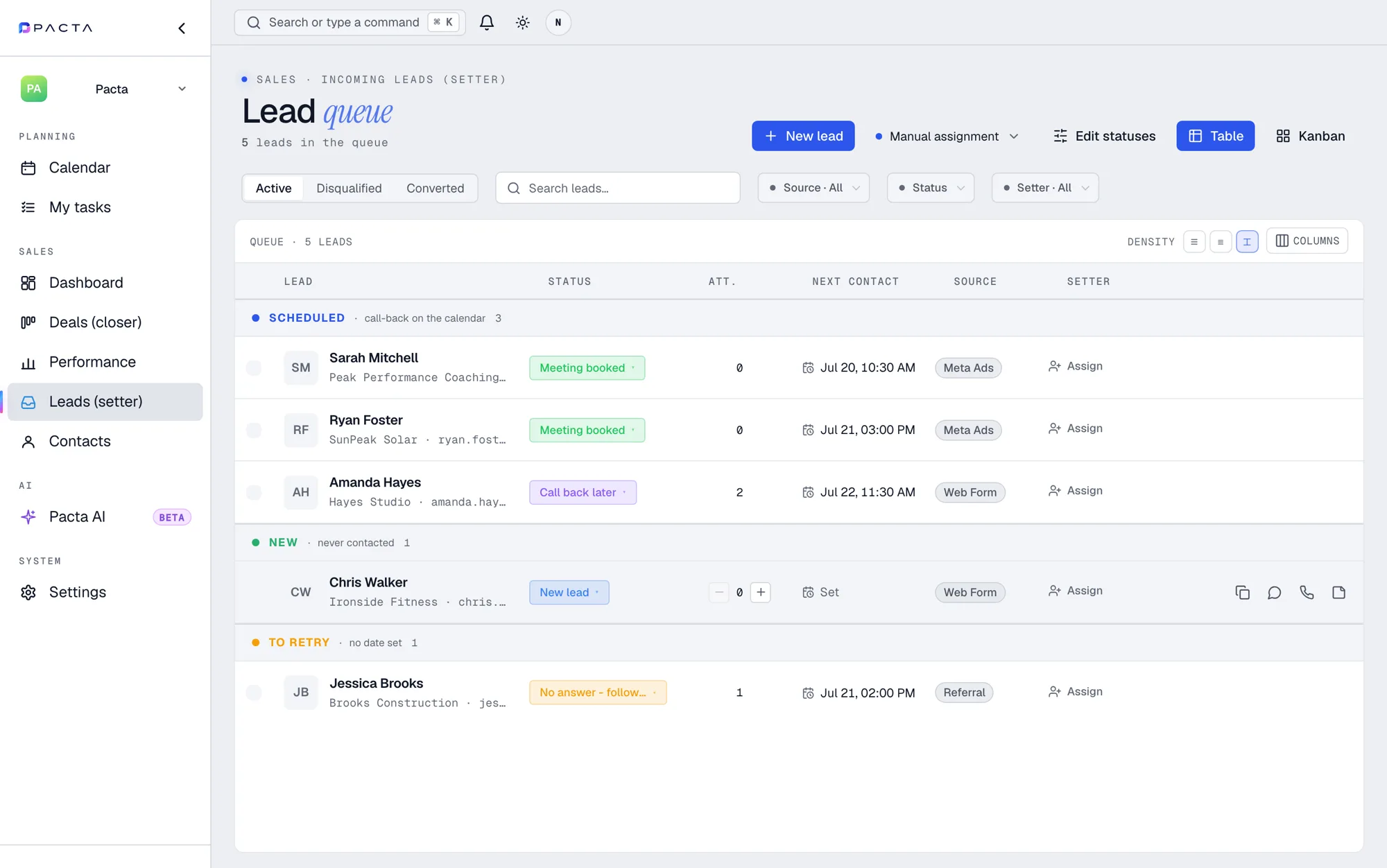
It's not a workaround in Pacta, it's the core object of the product.
Each role sees their own work. Setters open their lead queue: who to call, how many attempts, what's next. Closers open their pipeline. Managers see the funnel from lead to appointment to closed, with conversion rates at each step. Nobody wades through someone else's dashboard to find their day.
What happens after the call is where Pacta earns its keep.
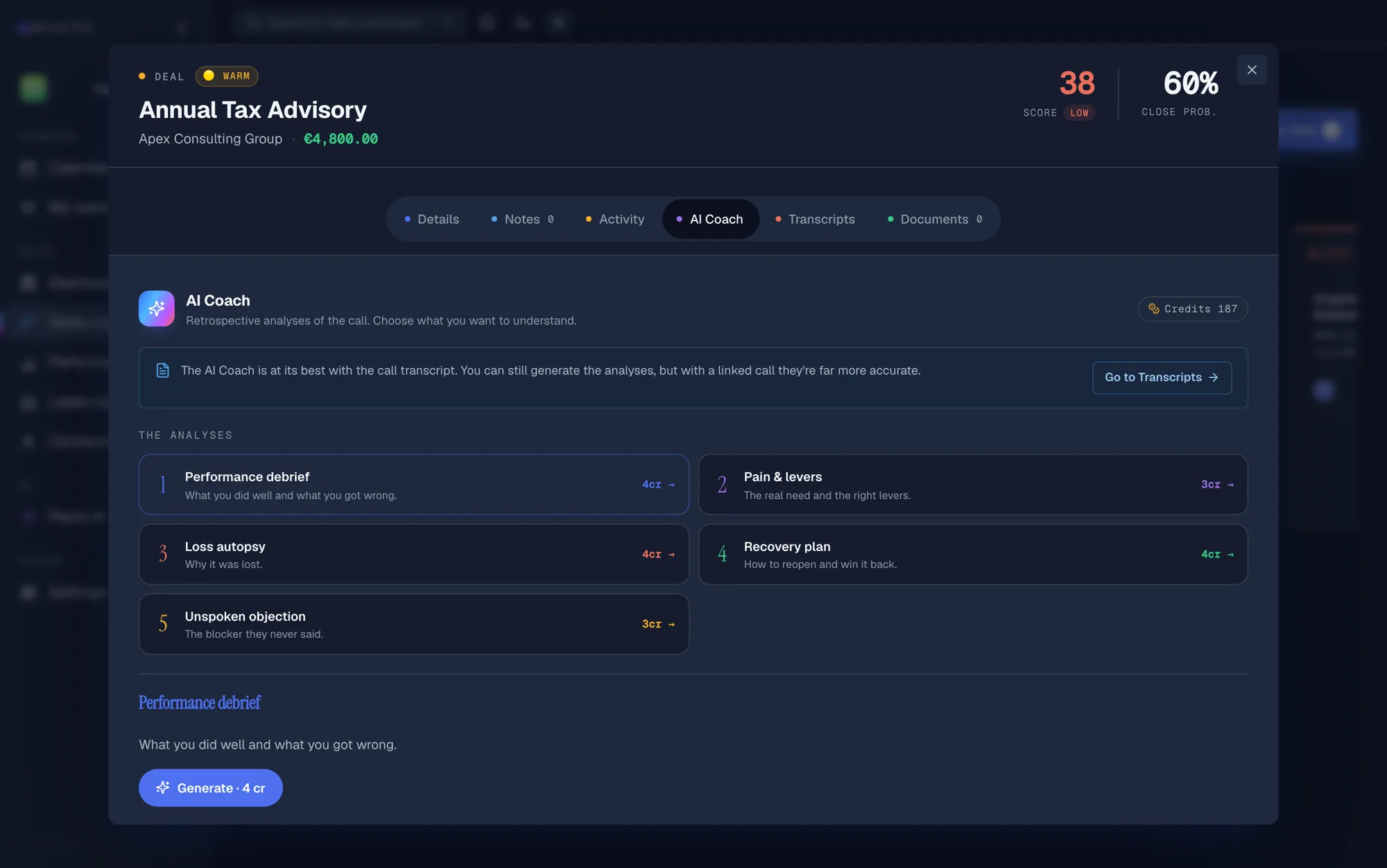
Every call becomes coaching.
Drop in the transcript (Pacta plugs into tools like Fathom) and the AI reads it like a sales manager with infinite time: what worked, where the call slipped, which objections came up and how your won deals handled the same ones.
Next steps get proposed, not remembered.
From that same transcript, Pacta drafts the follow-up: tasks, stage changes, appointments. Your closer approves with one click between calls. The deal moves forward even when the rep's head is already in the next conversation.
And your lost deals finally talk.
Objections across all deals get clustered and split by won versus lost, so you stop guessing which three objections are quietly killing your close rate. You'll know, and you'll know what the winning answers sounded like.
€59 a month with 3 users included. Each extra user: €20 a month. Pay yearly and it drops to €590, two months free.
Hire two setters next month and the bill goes up €40, not two more $99 licenses. A team of 10 pays about €199 a month. No usage meters, no locked modules. 14-day trial, no card required.
How the usual options handle this motion.
| What matters | Spreadsheets | Generic CRM | GoHighLevel | Pacta |
|---|---|---|---|---|
| Setter lead queue | Manual | Bent into shape | DIY build | Native |
| Traceable setter to closer handoff | No | No | Via automations you maintain | Native |
| AI coaching from call transcripts | No | No | No | Yes |
| AI-proposed next steps | No | No | No | Yes |
| Won vs lost objection insights | No | No | No | Yes |
| Time to value | Instant, until it collapses | Days | Weeks | An afternoon |
| Price for a team of 10 | Free, paid in lost leads | Per seat, climbs | From $97/mo + usage | €199/mo (€59 + 7 × €20) |
The answers you are looking for.
Does Pacta record my calls?
We're 4 people. Is this overkill?
Where do our leads come in from?
Can my setters see the closers' deals?
How is this different from GoHighLevel?
Your setters book. Your closers close. Nothing gets lost in between.
Try Pacta free for 14 days, no card. Running in an afternoon.