Gong alternatives for small sales teams, tested honestly (2026)
Gong earned its reputation. It defined conversation intelligence, the category of AI that reads your sales calls and tells you what's actually happening in them, and at enterprise scale it's still the benchmark.
The problem is the invoice. Gong is priced for companies with procurement departments. If you run a small high-ticket team, a coaching business, an agency selling retainers, a lean B2B sales floor, you're being asked to fund revenue intelligence infrastructure when what you wanted was call review and coaching.
Disclosure: Pacta is one of the four alternatives below. Every Gong number in this article links to an independent source, and there's a whole section on when Gong is genuinely the right buy. Judge for yourself.
- Gong is enterprise-priced. A platform fee, per-seat licenses and mandatory onboarding, all on annual contracts.
- Small high-ticket teams want the 20%. Call review and coaching, not full revenue intelligence across the whole funnel.
- Pacta covers that inside the CRM. Deal-level call analysis from €59/month, where the deals already live.
- Stay on Gong if you run 30+ reps with a RevOps function and need enterprise revenue intelligence.
What Gong actually costs in 2026
Gong doesn't publish prices. Buyer reports and procurement data from 2026 converge on a three-part structure, and all three parts are mandatory:
- Platform fee: $5,000 to $50,000 per year, charged before the first seat.
- Per-seat licenses: roughly $1,300 to $1,900 per user per year depending on bundle. Foundations alone is reported at $1,400 to $1,600; add Engage and Forecast and a seat runs $2,880 to $3,000.
- Onboarding: mandatory, from $7,500 for small teams, well past $25,000 for mid-market.
Contracts are annual at minimum and often multi-year, with buyer guides reporting built-in renewal increases of 5-15% (Vendr tracks the same pattern). Several 2026 analyses also report seat minimums around 15 for new customers in some regions.
Now run the math on a 10-person team, floor scenario: $5,000 platform fee, ten Foundations seats at $14,000 to $16,000, onboarding at $7,500. That's $26,500 to $28,500 in year one, assuming the smallest possible platform fee and zero bundles. A mid-range platform fee or bundled seats push the same 10-person team past $50,000. At 25 bundled seats you're comfortably into six figures (independent breakdowns put effective year-one cost near $4,000 per user at that size).
For a 50-rep org with a RevOps function, that spend can pay for itself. For a 6-person closing team, it's the reason this page exists.
For a 50-rep org with a RevOps function, that spend can pay for itself. For a 6-person closing team, it's the reason this page exists.
When Gong is actually the right call
Honesty cuts both ways, so here's the profile where Gong is the correct answer and nothing below replaces it:
- You have 30-50+ reps and someone whose actual job is revenue operations.
- You need forecasting and pipeline inspection across the whole funnel, on top of call coaching.
- You want deal-risk alerts while deals are still open, and manager coaching workflows that hold up across hundreds of reps.
- Your stack runs deep on Salesforce and you want native, maintained integrations everywhere.
- Six-figure software line items are normal in your budget and procurement negotiates them for sport.
If you recognize yourself, buy Gong, negotiate the platform fee, and skip the rest of this article.
What small teams actually use Gong for
Behind most "Gong alternative" searches there's the same pattern. Small high-ticket teams buy conversation intelligence for four jobs: review calls without rewatching them, coach reps on what really happened, spot the objections that keep killing deals, and stop follow-ups from slipping.
That's maybe 20% of Gong's surface. The other 80%, forecasting AI, initiative tracking, revenue analytics across hundreds of reps, is what the platform fee pays for. So the honest question is not "what's the cheapest Gong". It's "who does that 20% well, at a price a small team can defend". Four answers below.
The honest question is not "what's the cheapest Gong". It's "who does that 20% well, at a price a small team can defend".
The alternatives
1. Pacta, if you want the coaching layer inside your CRM
Best for: high-ticket teams running a setter-to-closer motion who want call analysis living where the deals live.
Pacta is a seller-first CRM with the conversation layer built in, not another tool bolted onto your stack. After each call it reads the transcript and runs a retrospective analysis on the deal, from five angles: what moved it forward, what stalled, which objections came up and how they were handled. Objections aggregate across the pipeline, split by won versus lost, so you learn which ones actually kill deals and how the winning calls answered them. Next steps, follow-ups and stage changes get proposed automatically; the rep approves with one click. And because it's the CRM, the setter-to-closer handoff, the pipeline and the funnel numbers live in the same system as the coaching.
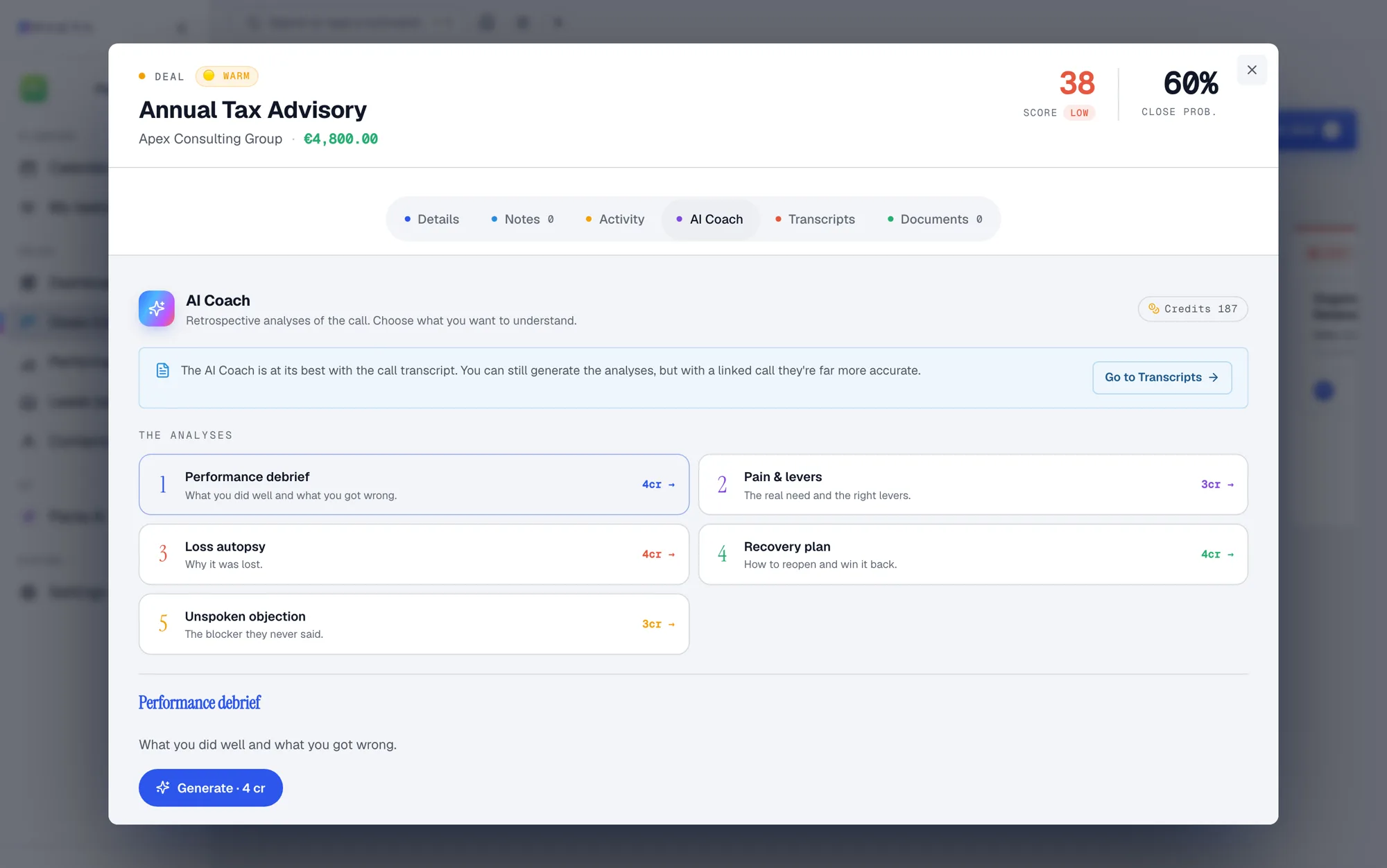
What it doesn't do, stated plainly: Pacta doesn't record calls and doesn't send a bot to your meetings. It connects to the transcripts your notetaker already produces (Fathom works natively) and analyzes them after the call. No real-time guidance either: the analysis is retrospective by design, built for the deal review and for the next call.
Price: from €59/month (3 users included, €20 per extra user), full CRM included. 14-day trial, no card.
2. Fathom, if you want to start free today
Best for: teams with zero budget that need recording, transcription and summaries right now.
Fathom's free plan records and transcribes without limits; the trade-off is that advanced AI summaries are capped at 5 calls per month on free. The Team Edition, around $15 per user per month billed annually, adds a shared call library, playlists, call metrics and coaching insights. It's the easiest entry point on this list, and the transcripts it produces are exactly what a tool like Pacta plugs into.
The catch: Fathom is a meeting tool. Insights live per call, not per deal, there's no pipeline, and coaching depth is light next to purpose-built conversation intelligence.
Price: free plan; Team Edition ~$15/user/month billed annually.
3. Avoma, if you want Gong's feature list at SMB pricing
Best for: teams that want scorecards, automatic call scoring and coaching dashboards as a dedicated tool.
Avoma is the closest functional cousin to Gong here: meeting assistant plus a Conversation Intelligence module with scorecards (MEDDIC, SPICED, BANT), auto call scoring and performance dashboards. Pricing is modular: plans start at $19 per user per month, Conversation Intelligence is a $29 add-on, so call scoring starts around $48 per rep, and a fully equipped rep with Revenue Intelligence lands near $77. No platform fee, no mandatory onboarding.
The catch: modular pricing adds up seat by seat, and it's still a separate system from your CRM, with the sync and adoption work that implies.
Price: from $19/user/month; realistic sales setup $48-77/user/month.
4. Fireflies, if the job is transcription across the whole company
Best for: cheap, reliable transcription and searchable meeting memory for every department, sales included.
Fireflies does unlimited transcription on every plan including free, with Pro at $10 per user per month and Business at $19 (billed annually) adding conversation intelligence analytics and CRM sync. For the money, the breadth is unmatched.
The catch: it's a notetaker with analytics on top, not a coaching system. Fine for meeting memory, thin for deal review, and some AI features meter through a credits system worth checking against your call volume.
Price: free plan; paid from $10/user/month billed annually.
The honest decision table
| Your situation | Where to go |
|---|---|
| 30-50+ reps, RevOps function, forecasting mandate | Gong |
| Small setter-closer team, want coaching where deals live | Pacta |
| Zero budget, need recording and transcription today | Fathom |
| Want scorecards and call scoring as a dedicated tool | Avoma |
| Whole-company transcription at the lowest per-seat cost | Fireflies |
| Already using a notetaker, missing the deal and coaching layer | Pacta |
FAQ
How much does Gong cost?
Buyer-reported 2026 pricing: a platform fee of $5,000 to $50,000 per year, plus per-seat licenses around $1,300 to $1,900 (up to $3,000 bundled), plus mandatory onboarding from $7,500. A 10-person team typically lands between $26K and $50K+ in year one, on an annual or multi-year contract.
Is there a free Gong alternative?
Two real ones: Fathom's free plan and Fireflies' free tier. Both are notetakers rather than coaching platforms, but they cover recording and transcription without a contract.
Does Pacta record my sales calls?
No, and that's deliberate. Pacta connects to the transcripts your notetaker already produces (Fathom natively) and analyzes them after the call. You keep your recording setup; Pacta adds the deal-level coaching layer on top.
What's the best Gong alternative for a small high-ticket team?
Depends on the missing piece. No recording setup at all: start with Fathom, the free plan is enough. Want a standalone scoring tool: Avoma. Want the coaching inside the CRM your setters and closers already work in, at a predictable price: that's the job Pacta was built for.
Can a small team just buy Gong anyway?
Sometimes not even if you want to. Multiple 2026 analyses report seat minimums around 15 for new customers in some regions, and the fixed platform fee makes per-user economics brutal below 20 reps. Under that size, the consensus across independent pricing breakdowns is that Gong is hard to justify.
Sources
Gong pricing: MarketBetter · Nimit · Convo · tl;dv · Vendr · Revenue Grid · MaxIQ. Fathom: official pricing · alfred. Avoma: official pricing · Docket. Fireflies: official pricing. All checked July 2026.
Keep reading
Try Pacta free for 14 days
The CRM built for people who sell. Set it up in a day and let the AI prepare the work for you.