The setter-to-closer handoff: a playbook for high-ticket sales teams
Most high-ticket teams don't lose deals on the call. They lose them between calls.
The setter does their job: qualifies the lead, handles the first objections, books the slot. The closer does theirs: shows up, runs the script, asks for the sale. And in between sits the most neglected moment of the entire sales motion: the handoff. No owner, no standard, no trail. A calendar invite and good intentions.
This breaks the same way in team after team, and it always looks like something else: "our close rate dipped", "leads from that campaign are weak", "the new closer isn't ramping". Pull the thread and it's the handoff. This playbook is the fix: the SOP, the data that must travel, the metrics that expose leaks, and the attribution rules that stop commission fights before they start.
- The handoff is the leak. Deals die between the setter's booking and the closer's call, not on the call itself.
- Five fields must travel with every booked call: source, qualification notes, objections already raised, touch history, and the commitment made.
- Make it a state, not a note. A traceable handoff with a named owner and a next-step date beats "follow up soon" every time.
- Settle commission attribution in writing before it's worth arguing about, and let the system be the source of truth.
Why the handoff is where deals die
Three failures, and every team has at least one.
Context evaporates. The lead told the setter about budget, timing, and a skeptical business partner. None of it reaches the closer, who then spends the first ten minutes rediscovering what the company already knew, and burns trust doing it. Buyers hate repeating themselves. It reads as "this company doesn't talk to itself".
Attribution blurs. Whose booking was this? Which setter gets credit for the show? For the close? When these answers live in memory or a messy sheet, you don't just get accounting problems. You get setters who stop caring about lead quality, because quality isn't measured back to them.
No-shows go unowned. The slot passes, nobody's sure whose job the rebook is, and a lead that cost real ad money quietly expires. Multiply by a month and it's the most expensive silence in your P&L.
Most high-ticket teams don't lose deals on the call. They lose them between calls.
The five fields that must travel with every handoff
If only one thing survives from this article, make it this list. Every booked call travels with:
Format matters less than enforcement. A shared doc works at 5 calls a week. It stops working long before 50.
The handoff SOP (steal this)
Qualification gate
Define, in writing, what "qualified" means (budget floor, decision authority, timeline). A setter can't hand off what doesn't pass the gate. This single rule protects closer calendars from becoming a charity.
The handoff happens at booking, not before the call
The moment the slot is set, the deal changes owner: it enters the closer's pipeline with the five fields attached. Not the morning of the call. Ownership gaps of even a day create the "I thought you had it" dead zone.
Closer pre-call review, 3 minutes, non-negotiable
The closer reads the five fields before every call and opens with continuity ("you mentioned to Marco that Q4 is tight, let's start there"). This one habit measurably changes how calls open.
No-show protocol with a named owner
Rebook attempt within 15 minutes (the show-up window is brutal), setter owns re-engagement if the rebook fails, and the deal gets a "no-show" state of its own. Not "lost". Not limbo. A state you can count.
Post-call, the loop closes
Outcome logged, next step with a date, and the setter gets visibility on what their booking turned into. Setters who see their leads' outcomes self-correct on quality within weeks. Setters who don't, don't.
The metrics that expose a leaking handoff
| Metric | What it tells you | Warning sign |
|---|---|---|
| Booked → show rate | Whether setters set real expectations | Below ~60% on warm traffic |
| Show → close rate | Closer effectiveness on qualified leads | Varies by offer; watch the trend, not the number |
| Time from booking to call | Momentum decay | Beyond 3-4 days, shows drop hard |
| No-show → rebooked rate | Whether anyone owns the recovery | Below 30% means nobody owns it |
| Qualified-handoff rate per setter | Lead quality per setter, not just volume | One setter far below the others |
Volume metrics (dials, bookings) tell you people are busy. These five tell you whether the machine converts. Track them per setter and per closer, weekly, or the averages will hide exactly the person who needs help.
Commission attribution: settle it in writing before it's worth arguing about
The fights are predictable, so pre-empt them: what the setter is paid on (booking? show? close?), what happens when a lead rebooks with a different setter, who gets credit on a 90-day-later revival, and how a reassigned deal splits. There's no universally right answer. There is a universally wrong one: deciding case by case, in the heat, with money on the table. Write the rules once, and make the system (not memory) the source of truth for who touched what, when.
Tooling: what this looks like in practice
You can run everything above on a spreadsheet, and at low volume you should. The five fields become columns, the SOP becomes discipline, the metrics become a weekly hour of manual counting.
The breaking point arrives with scale: the second closer, the fifth setter, the fiftieth call each week. The columns stop being filled in, the pre-call review gets skipped, the no-show protocol depends on who remembers. At that point the fix isn't more discipline. It's tooling that makes the right behavior the default: a handoff that carries the five fields automatically, states you can count, attribution the system remembers so nobody has to.
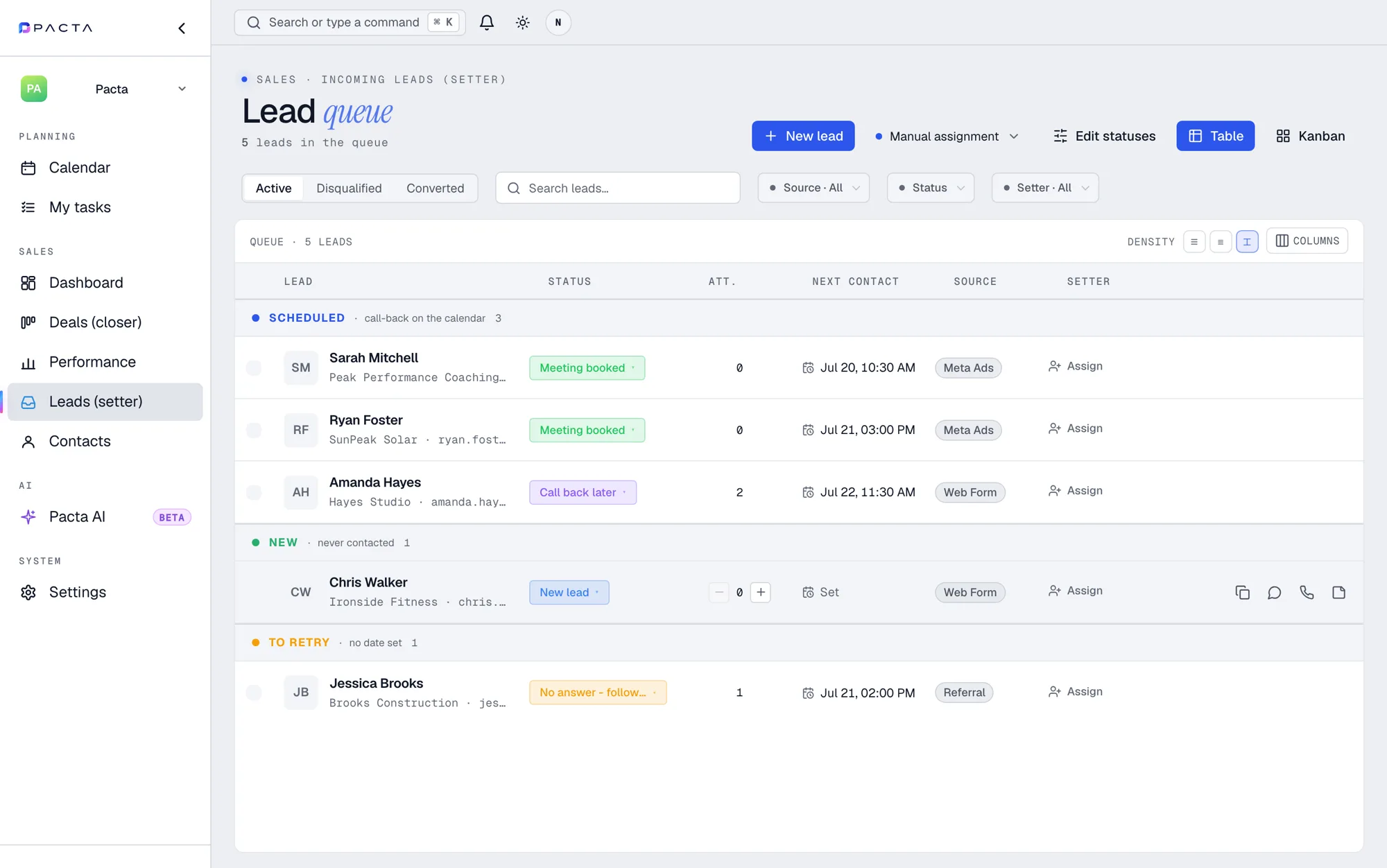
This is the exact problem Pacta is built around (the handoff is a native object there, and an AI reads each call transcript afterwards to propose the next steps). If you're evaluating tools for a setter-closer motion, that's the lens to use on any of them, Pacta included: does the handoff carry context by default, or does it depend on people remembering to be diligent?
FAQ
At what team size does the handoff need a system?
The honest marker isn't size, it's the moment the founder stops personally seeing every deal. For most teams that's the second closer or the fourth setter, whichever comes first.
Should setters be paid on bookings or closes?
Hybrid usually wins: a small amount per qualified show (not per booking, or you buy calendar spam) plus a percentage on closes from their leads. It aligns quality without making setters wait a full sales cycle to eat.
What's a good show rate?
On warm inbound traffic, 65-75% is healthy. Below 60%, look at expectation-setting in the booking conversation and the booking-to-call delay before blaming the leads.